Memory Clean Mac 10.6 8 Download
How to clean upward and declutter your Mac

Suddenly a dialog box pops up on your screen: 'Your Startup Deejay is full'. It'south the terminal confirmation of what you've been dreading - your hard drive has finally run out of infinite and now yous've got to practice something about it. The question is, what?
Y'all might exist shocked at seeing the message. When yous booted up your shiny new Mac for the first time, yous couldn't believe how much hard drive space there was - you were confident you'd never fill information technology upwards, and withal here yous are, a matter of years (or even months) afterward, and you've gobbled up every last ounce of capacity.
Don't panic, though, considering we'll show you everything you need to know to solve the trouble. You'll larn to place the tell-tale signs of a apace constricting drive, plus discover what files are likely to be the crusade of your woes. You'll then be armed with 10 tips to gratis upward space on your bulldoze.
Once you've fought that fire, we'll reveal more permanent solutions to the trouble of keeping your drive empty so information technology tin do its job properly: from moving key libraries and other files to a second bulldoze, to safely upgrading your existing system drive to a larger, faster model. It'south all hither, and then read on to become a disk-cleaning wizard.
Where does all the space go?
With all that free infinite disappearing fast, you need to understand both where it'southward gone and the consequences of letting your hard drive fill upwardly to its limits.
The first thing to understand is how your hard drive has get and so full. The likelihood is you've installed a off-white few applications, some of which you were trying out and forgot all well-nigh during those heady days when yous thought that infinite would terminal forever. That tin can business relationship for a few gigabytes of infinite hands, merely it's only the tip of the iceberg.
Next, at that place are all those files you've downloaded from the internet via your browser, or received as electronic mail attachments. Again, information technology's easy to let them only pile upwardly on the off-chance you might need them at some unspecified point. All well and good, but yet more than gigabytes of precious drive space have gone in the meantime.
The biggest drain on your difficult bulldoze will, still, be your personal files, and specifically all those photos and videos you lot've uploaded from your brand spanking new camera and camcorder. Today'south loftier resolutions come up at a toll - every ten-megapixel photograph consumes effectually 4MB in JPEG format, or up to 15MB in raw format. That equates to anything from 400MB to i.5GB for every 100 photos on your hard drive.
It'southward even worse when you look at all the camcorder footage you've got stashed away. The average one hour HDV tape holds 13GB of data, so information technology doesn't take long to gobble up hundreds of gigabytes with your original footage, never mind the final edited movie.
It doesn't end there either: your iTunes library tin can consume more than than its off-white share of space, what with your music collection, podcasts, movies and TV shows to handle.
Yous might also be surprised to acquire how many duplicated files exist on your hard bulldoze - it's bad enough having 2 or three copies of a file, but when that file is a 10GB movie you tin can quickly meet how information technology is that the hard drive that looked near bottomless a few months agone is suddenly full to the brim.
Facing the consequences
It's therefore obvious that even the largest hard drive can quickly get overwhelmed with all those files you've been copying to information technology. Having acknowledged that this isn't just a problem for MacBook Air owners with a paltry 64GB of bulldoze space, what are the tell-tale signs that your bulldoze might be starting to reach its limits?
The beginning landmark isn't one that will necessarily trigger whatever alerts, and occurs when your drive nears 90% of its capacity. Your Mac needs at least 10% free space on the bulldoze to help information technology continue files in a neat, contiguous order (a process known as defragmentation).
Every bit your bulldoze fills up and the defrag process grinds to a halt, your files commencement to become split up into multiple parts to fit the bachelor infinite, catastrophe up physically scattered all over your drive.
File fragmentation may non be an effect for newer solid-state drives (SSDs) due to their lack of moving parts and an power to access any part of the drive almost instantaneously. But for the vast majority with traditional drives (HDDs) which apply rotating platters and mechanical drive arms, fragmentation is the first tell-tale sign that all is not well.
Y'all'll beginning to detect performance suffer as the drive works harder to read and write files. Your Mac becomes increasingly sluggish. You lot're not doing your drive's physical health any favours either since its moving parts accept to work harder, increasing drive temperature and ultimately shortening its lifespan.
Running out of space
The next milestone is reached as the amount of gratuitous space drops beneath 1GB. Certain applications may start to display warning letters, and performance slows fifty-fifty farther.
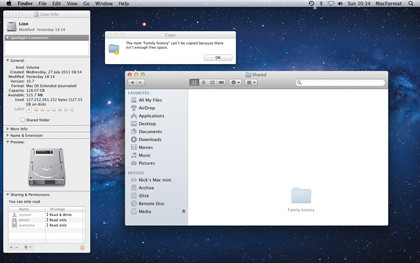
Your Mac itself will start to tell you the drive is full or near full, and exhort you lot to start freeing up space. You'll besides beginning to get error letters every time you try to re-create large folders to your bulldoze, informing you there's non enough drive space to complete the functioning.
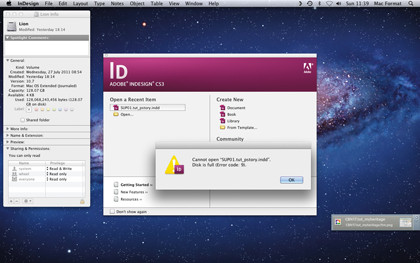
Push things further, and as your free infinite dips below 100MB you lot'll find things get even worse. Applications routinely 'borrow' tens or even hundreds of megabytes of infinite when running, and the most resource-intensive applications will start to complain loudly about a lack of drive space, or even refuse to start at all.
Eventually you'll accomplish the final point: there will be little or no disk space left at all. Applications won't even be able to launch, while those applications already running may suddenly grind to a halt or brainstorm to quit unexpectedly. Hopefully you lot'll never attain this point: the time to have activeness is when your difficult bulldoze approaches the 90% full mark, before any warning messages start to appear.
Diagnose the problem
The first thing to practise, then, is observe out how much free space is left on your system drive. Yous'll and so want to identify which files are taking upward the most space on your drive - information technology'due south quicker and easier to deal with a handful of large files than to try and free up a relatively small corporeality of space by working with dozens or fifty-fifty hundreds of smaller files.
Information technology's a relatively unproblematic process to notice how much free space is left on your hard bulldoze: open up the Go menu in Finder and select Computer. Click your system drive to select it, then printing Control + I. (Alternatively, correct-click the hard disk icon in Finder'southward sidebar and select Go Info.)
On its own, this doesn't really tell y'all much - simply how much free space is left on the drive. While it's possible to use the Observe option in Finder to hunt downward those files taking up most space on your difficult drive, a meliorate bet is to use a tool like the visually appealing DaisyDisk or Deejay Inventory X to notice out where those space-hogging files are.
In the case of Disk Inventory X, fire up the program later installing it. Select your drive from the list and click Open up Book. In one case the bulldoze is scanned, you lot can quickly and easily locate the files taking up about space.
What Disk Inventory X will confirm is that the bulk of your files reside in the Users binder inside your Home folder. That'southward unsurprising seeing as this is where all your movies, photos, music and other files are likely to sit.
Now you've acknowledged there's an issue, identified the probable culprits and taken that all-important fill-in of your drive, yous're fix to showtime tackling the problem.
Memory Clean Mac 10.6 8 Download
Posted by: lopezhice1948.blogspot.com